By Victoria Martínez
This is slightly modified excerpt from my chapter titled “‘Our duty to present and future generations’: Victims’ Efforts to Document the Nazi Atrocities,” in the book The Holocaust as European Memory: 80 Years Since the Liberation of Auschwitz, edited by Ulf Zander (Lund: Sisyfos förlag. 181 p. NORAH:s skriftserie; vol. 1, pp. 87-101, here pp. 93-94).
“There is an original document, dated April 6, 1945, which is one of the departure lists for the mythical camp called Mittwerda—perhaps the last such list, but in any case the only one which, to my knowledge, remains intact. It includes 480 names,” explained Germaine Tillion, a French survivor of the Ravensbrück concentration camp, in her 1973 book titled Ravensbrück. “The identical meaning of ‘Mittwerda’ and ‘gas chamber’ had been obvious from the first to the prisoners who had the responsibility of maintaining the Mittwerda lists, since they recorded the names and numbers of the victims as they were taken away.”[i] The existence of this singular document showing the names of individuals sent to the gas chamber, known as the Mittwerda list, is thanks to former Polish political prisoner Halina Strzelecka (1907–1968), who was involved in the early collection work in Sweden of survivor evidence and testimony and who later became one of the nine survivor employees of the Polish Research Institute in Lund. In her 1945 witness statement in the Polish Research Institute collection, Strzelecka declares, “I took this letter from files in a drawer belonging to SS-Oberscharführer Heintz [sic, Hans] Pflaum. This list is one of many lists under which transports went to the gas chamber and which vanished without a trace.”[ii] Having risked her life to take the list, Strzelecka brought it with her to Sweden when she arrived there as a repatriate in May 1945. She allowed the group to make a photocopy of the list, thus adding a key piece of evidence to the Polish Research Institute collection.[iii]
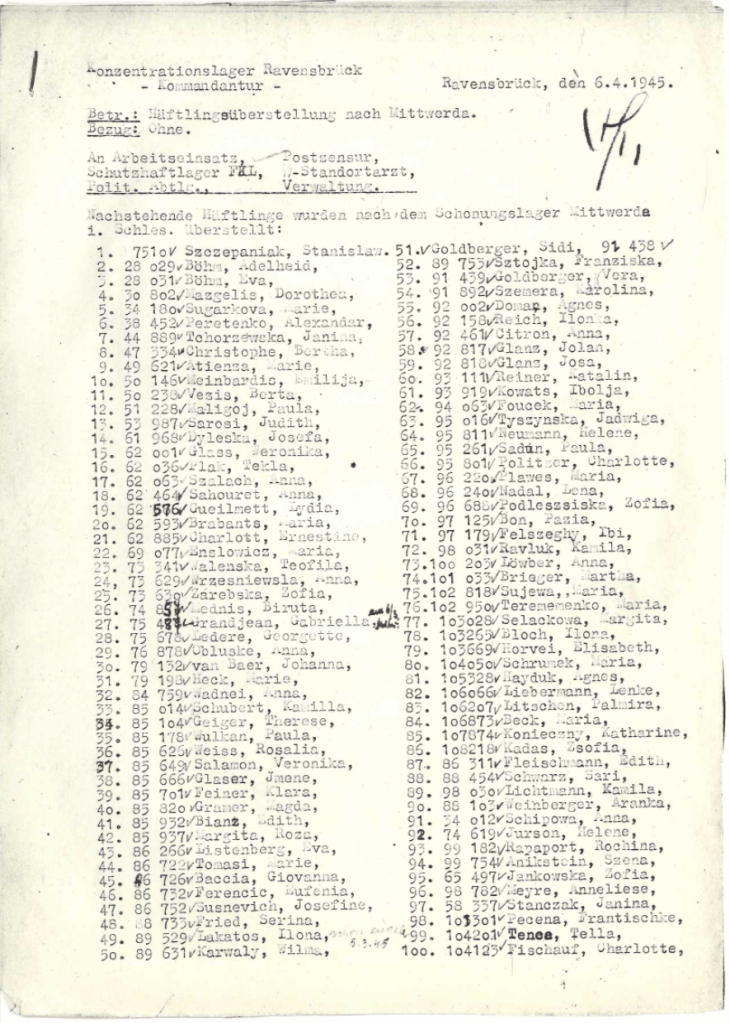
Perhaps the most important function this copy of the Mittwerda list served was helping to convict Ravensbrück commandant Fritz Suhren, who signed the list. Initially arrested by the British army in 1945, Suhren escaped in November 1946, just before he was to be put on trial as part of the Hamburg Ravensbrück trials, 1946–1948. In 1949, he was arrested in Bavaria by United States soldiers and transferred to French jurisdiction for prosecution. Under interrogation, Suhren denied that he was involved in the murder of prisoners in the gas chamber, a claim the Mittwerda list directly contradicted. It was therefore an essential document to convict Suhren. The problem was that the French prosecutors did not have a copy and could not get one through the usual “hierarchical channel” in time for the trial. Consequently, the French Examining Magistrate asked Germain Tillion to obtain a copy through her own channels. Aware that a copy of the list was held by the Polish Research Institute in Sweden, Tillion contacted former institute employees she had known in Ravensbrück, non-Jewish Polish survivor Helena Dziedzicka and Ludwika Broel-Plater in late 1949. “The Mittwerda list is of great importance because it is an irrefutable document proving SUHREN’s responsibility for the extermination of the camp,” Tillion wrote to Broel-Plater.[iv] Broel-Plater fulfilled Tillion’s request in time for the list to be used as evidence in Suhren’s trial, which ended with a guilty verdict.[v] Had it not been for Halina Strzelecka’s courageous act of “stealing” this list and smuggling it out of Ravensbrück, this might not have been possible.
Extracted from: Martínez , V. V. O. (2025). “Our duty to present and future generations”: Victims’ Efforts to Document the Nazi Atrocities. In U. Zander (Ed.), The Holocaust as European Memory: 80 Years Since the Liberation of Auschwitz (pp. 87-101). (NORAH:s skriftserie; Vol. 1). Sisyfos förlag, pp. 93-94.
Further Sources and Reading:
“Witnessing Genocide” – the website of the UNESCO Memory of the World “Ravensbrück Archive” at Lund University Library
Martínez, Victoria Van Orden. “Women’s Work, Women’s Networks: Correspondence and Knowledge Circulation Between the Polish Research Institute in Lund and Survivor Historical Commissions in the Early Postwar Period”. History of Intellectual Culture 4/2025: Gender, Archiving, and Knowledge Production after the Holocaust. A Postwar Republic of Letters?, edited by Charlotte A. Lerg, Johan Östling, Jana Weiß, Victoria Van Orden Martínez, Christine Schmidt and Ewa Koźmińska-Frejlak, De Gruyter Oldenbourg, 2025, pp. 105-128. https://doi.org/10.1515/9783111636726-005
Martínez , V. V. O. (2025). An eternally grateful refugee? Silences in Swedish public discourse and the (de)historicization of Polish-Swedish activist Ludwika Broel-Plater. In J. Leinonen, M. Tervonen, H. O. Frøland, C. Hoffmann, S. Jalagin, H. Vad Jønsson, & M. Thor Tureby (Eds.), Forced Migrants in Nordic History (pp. 203-223). Helsinki University Press. https://doi.org/10.33134/HUP-32-9
Martínez , V. V. O. (2024, Aug 27). Suffering, Displacement, and the Circulation of Knowledge about Nazi Atrocities. German Historical Institute in Washington, DC. https://migrantknowledge.org/2024/08/27/suffering-displacement-and-knowledge/
Martinez, V. (2022, Dec 12). Documenting the Documenter: Piecing together the history of Polish Holocaust survivor-historian Luba Melchior. European Holocaust Research Infrastructure project (EHRI). https://blog.ehri-project.eu/2022/12/12/luba-melchior/
[i] Germaine Tillion. Ravensbrück, Gerald Satterwhite (trans.), Garden City, N.Y.: Anchor Press, 1975 [1973], p. 147.
[ii] Record of Witness Testimony No. 192, Helena [Halina] Strzelecka, November 19, 1946, 7, The Polish Research Institute in Lund archive, http://urn.kb.se/resolve?urn=urn:nbn:se:alvin:portal:record-102717. Bracketed information in original.
[iii] ibid; “The Polish Research Institute in Lund (PIZ) archive” (Lund University Library, Sweden), volume 30: 5. “Mittwerda.”
[iv] Zygmunt Łakocińskis arkiv (ZL) (Lund University Library, Sweden), volume 41, letter from Germaine Tillion to Ludwika Broel-Plater, in French, datelined Paris, December 31, 1949. Capitalizations in original. Translated from French by this author.
[v] Tillion describes this episode and mentions Dziedzicka and Broel-Plater in Tillion, Ravensbrück, pp. 147–152.
 A Bit of History